London drivers face a brutal test. It is not a simple driving exam. To earn the right to drive a Hackney carriage, an individual must master The Knowledge. This process requires memorising roughly 25,000 streets and 100,000 specific points of interest. These landmarks include everything from tiny pubs in Soho to massive hospitals like St Thomas’. It is a mental feat that takes most people between two and four years to complete. While many people use sat-navs for basic trips, a qualified cabbie relies on a mental map built through thousands of hours of physical study. This expertise defines the black cabs guide we often discuss. The difficulty is legendary. It remains one of the most demanding vocational qualifications in the United Kingdom. We will examine the historical evolution of these regulations, the neurological impact of such intense study, and the modern financial pressures facing new candidates. You will learn about the specific stages of the examination process, the costs of vehicle ownership, and how this tradition compares to international standards.
Victorian roots and the Public Carriage Office
London needed order. Before strict regulation, the streets were a chaotic mess of unregulated horse-drawn vehicles. Following the era of the Great Stink and subsequent policing reforms, the government sought more control over urban transport. The Public Carriage Office took on its modern role in the 1860s. This body eventually transferred to the Metropolitan Police in 1869 so that standards could be enforced by law.
The rules changed everything. Regulation ensured that every driver met specific standards of conduct and geographical awareness. This historical foundation created a professional class of drivers who were accountable to the city. The system grew slowly over decades. It evolved from managing horses to managing internal combustion engines, but the core requirement remained the same. A driver must know the city intimately.
The regulatory landscape shifted again in 2000. Responsibility for taxi licensing moved from the Metropolitan Police to Transport for London (TfL). This change brought modern oversight to an ancient trade. We can track these shifts through records at the London Transport Museum. The transition ensured that safety and accessibility remained central to the service.
The mechanics of the Blue Book
The curriculum is structured around “runs”. These are specific routes that a student must master perfectly. Most runs begin within a six-mile radius of Charing Cross. This central point acts as the anchor for the entire map.
There are 320 set runs in total. A student cannot simply guess their way through these exercises. They must demonstrate they can find the most efficient path between any two points while avoiding major obstacles. This is why understanding how to become a black taxi driver in London requires such intense discipline.
The Blue Book serves as the bible for this process. It dictates the routes and the expected precision. If a student misses a turn, they often have to restart the entire run. Accuracy is non-negotiable. You must know where the embassies are located in Belgravia and which theatres sit on Shaftesbury Avenue.
The examination format
An examiner picks two points within that six-mile radius of Charing Cross. The candidate must then call out the route turn by turn without looking at a map. They must account for one-way streets, pedestrianised zones, and specific turning restrictions. A single error often results in an immediate failure for that session.
A grueling path to qualification
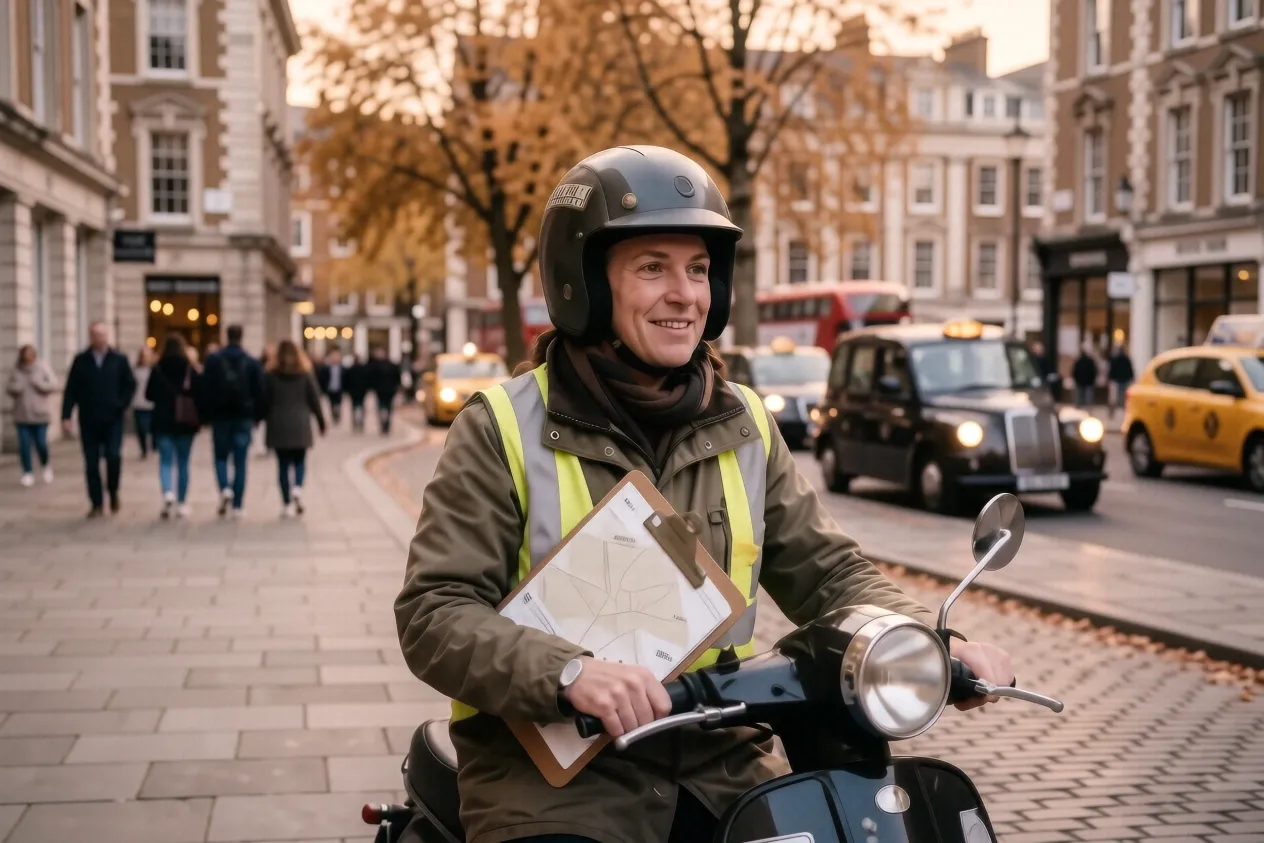
The journey begins with an introductory talk. After this, students enter a phase of intense self-study. Many “Knowledge boys” or girls can be seen zipping around on mopeds—a common sight in the dense traffic of Central London. These small vehicles are faster for covering long distances between landmarks. They aren’t just driving; they are memorising.
The process involves a series of oral exams known as “appearances”. Students must pass through three distinct stages to prove their competence. The first stage is often a basic check of local knowledge. The second stage requires more complex routing across different boroughs. The final stage tests the candidate’s ability to handle difficult or unusual requests under pressure.
A student must accumulate enough successful appearances to satisfy TfL requirements. It is a slow, grinding accumulation of points. Attrition is high. Roughly 50% of those who start the process never actually finish it. The two-to-four-year timeframe is an average, not a guarantee.
Training support and schools
Many students seek professional help to pass. Schools like Knowledge Point School provide structured guidance for those struggling with specific districts. Other instructors offer private tuition to refine a candidate’s route calling. Without this help, the mental load can become overwhelming.
The cost of mental mastery
Becoming a cabbie is expensive. There is no formal salary during the study period. Most students must work other jobs to survive while they spend their days on the streets. This creates a massive financial gap for many families.
TfL charges a fee of around £550 for the qualification itself. However, the true cost lies in lost income. If you spend three years studying, you are missing out on years of full-time earnings. We estimate this lost opportunity costs between £30,000 and £50,000.
Financial pressure is real. Many prospective drivers struggle to balance their current employment with the demands of how much taxi drivers earn once they finally qualify. The investment is significant. You are essentially paying for the right to enter a highly specialised labour market.
Vehicle financing and capital
Once qualified, a driver must secure a vehicle. This is where the cost spikes. Modern LEVC TX5 models cost around £60,000 new. Many drivers must take out high-interest loans to begin their careers. This debt can be difficult to manage during the first few months of driving.
Brain science and cognitive growth
The Knowledge does more than teach streets. It actually changes the physical structure of the brain. Cognitive science research has shown that qualified drivers often exhibit hippocampal growth. This is a documented biological change.
The hippocampus is the part of the brain responsible for spatial memory. Because drivers must constantly build and update a 3D mental map, the tissue physically adapts to this demand. This isn’t just about memorising names. It is about spatial reasoning at an elite level.
In 2000, researcher Eleanor Maguire published studies showing that London taxi drivers had larger hippocampi than control groups. Follow-up studies have reinforced these findings. The brain becomes a tool. It functions as a living, breathing database of the city’s layout.
Instinctive navigation
Memory becomes instinctive. A driver doesn’t “think” about where Fleet Street is; they simply know. This neurological shift distinguishes them from standard motorists. They possess a sense of direction that operates beneath conscious thought.
Modern threats and the digital age
Technology has changed the landscape. The expansion of Uber in London since 2012 has created intense competition for passengers. These apps often offer lower prices because they do not require the same level of qualification. This has squeezed the profit margins of traditional drivers.
Electrification adds another layer of difficulty. Moving to electric vehicle fleets requires significant capital investment. For an independent driver, the cost of a new electric LEVC TX can be daunting. The transition from diesel TX4 models to electric versions is expensive.
GPS is everywhere. Some argue that satellite navigation makes the Knowledge obsolete. However, this is rarely the case in dense central traffic. Knowledge drivers often route faster than a sat-nav. They know which streets are blocked by bollards or temporary closures that a digital map might miss.
Economic shocks
The COVID-19 lockdowns of 2020 and 2021 hit the industry hard. Passenger numbers plummeted while fixed costs remained high. Many drivers lost their livelihoods during this period. The recovery has been slow for many in the trade.
Comparing global standards
London’s system is unique. When compared to other major cities, the difficulty is clear. A Tokyo cabbie exam focuses heavily on etiquette and specific local routes but lacks the sheer volume of the London Blue Book. Paris taxi licences are often tied to a lottery or administrative points system rather than a multi-year spatial test.
The UK holds the title for the world’s hardest driving qualification. There is no equivalent in terms of pure geographical memorisation. This creates a barrier to entry that keeps the supply of drivers low. While this protects the quality, it also limits competition.
The Suburban Yellow Badge alternative
Not everyone wants the full rigour of the Black Cab. There is a different path available through the Suburban Yellow Badge. This qualification has a lower bar for entry. It is designed for specific districts outside the central London zone.
Drivers with this badge cover different areas and do not have the same freedom to pick up passengers anywhere in the city. Some choose this because it is faster to obtain. Others prefer it because they want to work in more predictable residential environments.
Frequently asked questions
How much does it cost to become a London taxi driver? The official TfL fee is approximately £550. However, you must factor in the cost of living while studying for three years. Most candidates lose between £30,000 and £50,000 in potential wages during this time. You also need to budget for vehicle financing once you qualify.
How long does it take to pass The Knowledge? The average timeframe is between two and four years. Some fast learners may finish sooner, while others take much longer due to the complexity of the routes. It depends on your ability to memorise 25,000 streets and 100,000 points of interest.
What is an “appearance” in the taxi exam? An appearance is an oral examination conducted by a TfL examiner. You must call out a specific route between two points within the six-mile radius of Charing Cross. If you make a mistake or miss a turn, the appearance is failed.
Can I use a sat-nav while driving a black cab? You can use technology for your own convenience, but it does not replace The Knowledge. A qualified driver should be able to navigate without any electronic assistance. Many drivers find that their mental map is actually faster than GPS in heavy London traffic.
Are black cabs wheelchair accessible? Yes, all licensed Hackney carriages must meet accessibility standards. Most modern models like the LEVC TX are designed to accommodate wheelchairs and passengers with mobility needs. This is a requirement under the Equality Act 2010.
What is the difference between a black cab and an Uber? Black cabs are Hackney carriages that can be hailed on the street or use taxi ranks. They must pass The Knowledge. Uber drivers are private hire vehicles who must be pre-booked via an app and do not undergo the same spatial training.
Do I have to accept assistance dogs in a taxi? Yes, under the Equality Act 2010, all taxi drivers must accept assistance dogs. Refusing a passenger because of their guide dog is illegal. This rule applies to both black cabs and private hire vehicles.
What are the different TfL tariffs? TfL uses three main tariffs. T1 is the base rate for Monday to Friday daytime. T2 is a higher rate for evenings and weekends. T3 is the highest rate, applied during late nights and public holidays.
What is an LEVC TX5? The LEVC TX5 is a range-extended electric vehicle. It uses an electric motor for driving but has a 1.5L petrol generator to charge the battery. This allows the cab to run efficiently without needing to plug in constantly during a shift.
Can children travel in a black cab without a car seat? There is a specific exemption in the Motor Vehicles (Wearing of Seat Belts) Regulations. While most children need seats, certain rules allow for flexibility in taxis. However, drivers are encouraged to prioritise child safety at all times.
Frequently asked questions
- How long does it take to pass the Knowledge?
- Most people spend between two and four years studying. It depends on how much time you can dedicate to the streets each day. Some fast learners might do it sooner, but the attrition rate is very high because of the sheer volume of information required.
- Is the Knowledge still relevant with GPS?
- Yes, it remains highly relevant. A trained driver understands the nuances of London's road layout that a computer often misses. They can find shortcuts through narrow streets and avoid areas where heavy traffic or construction makes navigation difficult for standard vehicles.
- What is the difference between a Black Cab and a Private Hire vehicle?
- Black Cabs are licensed Hackney carriages and can be hailed on the street or picked up at taxi ranks. Private hire vehicles, like those used by Uber, must be pre-booked through an app or over the phone. Only Black Cab drivers have passed The Knowledge.
- How much does it cost to qualify?
- The direct TfL fees are around £550, but this is a small part of the total cost. You must account for the lost income during your two to four years of study. Many people find it difficult to balance full-time work with the intense demands of the training.
- Can anyone become a London taxi driver?
- You must meet specific TfL requirements, including a clean driving licence and a criminal record check. You also need to be able to pass the rigorous medical and cognitive tests. It is a professional qualification that requires significant mental stamina and dedication.
- What are 'runs' in The Knowledge?
- Runs are specific routes that students must memorise. Each run starts from a certain point and follows a set path through the city. You must be able to complete these runs perfectly, without using any maps or digital aids, to pass your oral exams.
- Do drivers actually have larger brains?
- Scientific studies suggest that the intense spatial training leads to increased grey matter in the hippocampus. This is the area of the brain used for navigation and memory. It is a physical response to the massive cognitive load required to master London's streets.
- Why do students use mopeds?
- Mopeds are a practical tool for studying. They allow 'Knowledge boys' and girls to move quickly between different parts of the city without getting stuck in the heavy traffic that would slow down a car. It makes covering the required mileage much more efficient.
Sources
Published 11 May 2026.